An effective ORM strategy begins with an audit of what people already find about your brand. It then adds monitoring, review management, search optimization, and clear response processes.
Forrester’s 2025 Brand Experience Index found a 5 to 30-point gap between customer and noncustomer brand experience scores across industries and countries. That gap shows why reputation needs attention before a major issue appears. This guide explains how to build an ORM strategy from scratch, step by step.
What Is an ORM Strategy, and Why Does It Matter?
An ORM strategy is a planned system for monitoring and managing how people see a business or brand on the web. It includes reviews, search results, social discussions, news, forums, listings, and other public mentions.
Online reputation management is broader than wiping off negative reviews. It combines several activities that influence what customers find and believe about a business.
For example:
- Review management handles customer feedback and responses.
- SEO improves the visibility of useful and accurate pages.
- Social listening tracks conversations and mentions.
- Public relations manages media relationships and brand coverage.
- Digital Reputation Management connects these activities into one reputation plan.
An effective reputation management strategy also separates prevention from response. The goal is not to just hide every negative comment. It is to identify genuine problems, correct inaccurate information, and respond in a professional manner. All these help to build a stronger public record over time.
This is imperative for both individuals and companies. A customer may search a business before calling. A job candidate may search for an employer before applying. A journalist may also search a founder before requesting a comment.
That is why an online reputation management strategy for businesses should cover the full branded search experience.
How Do You Audit Your Online Reputation Before Starting?
Start by finding what is already there. Your first audit should create a clear base prior to starting any reputation work.
Search these combinations:
- Business or personal brand name
- Brand name + reviews
- Brand name + complaints
- Brand name + location
- Product or service name
- Founder or executive name
- Brand name + customer service
- Brand name + industry terms
Check the first two or three pages of Google. Then analyze your Google Business Profile, social profiles, directories, forums, review websites, and relevant news coverage.
Record the findings in a simple spreadsheet.
| Audit Item | What to Record | Example |
|---|---|---|
| Search results | Position and page | Brand page at #4 |
| Reviews | Rating and volume | 4.2 stars, 180 reviews |
| Response rate | Answered reviews | 65% |
| Negative themes | Repeated complaints | Slow support |
| Listings | Business details | 3 inconsistent phone numbers |
| Mentions | Important third-party pages | Industry publication |
Use this simple process:
Search → Record → Classify → Prioritize → Act
For example, a local HVAC company may find 20 unanswered Google reviews. It may also find three directories with different phone numbers.
Fixing these issues should happen before launching a large review campaign. A useful expert practice is to create a baseline reputation scorecard. Record ratings, review counts, response rates, branded search results, major mentions, and recurring complaints.
Without that baseline, it becomes difficult to prove what changed after your ORM services begin.
Which Online Reputation Channels Should You Monitor?
Your online reputation monitoring system should cover the channels that influence your customers. Do not monitor every website equally. Set a frequency based on risk, audience, and activity.
| Channel | What to Monitor | Frequency | Priority |
|---|---|---|---|
| Brand searches and reviews | Daily | High | |
| Review sites | Ratings and new reviews | Daily | High |
| Social media | Mentions and comments | Daily | High |
| News and forums | Brand discussions | Weekly | Medium |
| AI search | Brand answers and citations | Monthly | Emerging |
Google Search and your business profile usually deserve the highest attention for local businesses. Industry review sites can matter more for specific sectors. A hotel may monitor TripAdvisor. A home service company may focus on Google and local directories.
Also monitor mentions of:
- The company
- Main products
- Key services
- Founders and executives
- Important employees
- Brand variations and misspellings
AI search adds another layer. ChatGPT, Gemini, Claude, and Perplexity may present information gathered from multiple public sources. That makes consistency important. Conflicting business names, descriptions, services, or facts can create confusion across search experiences.
How to Build a Review Management System?
Online reputation matters as more customers buy online. Pew Research Center reported in 2025 that 92% of U.S. adults have bought something online. This makes reviews, seller info, and customer feedback important elements of an online reputation management strategy.
Start by identifying the best point after a customer interaction. For example, a home service company could request feedback after completing a job and confirming customer satisfaction. Google provides businesses with review links and QR codes for requesting genuine customer feedback. It also prohibits incentives offered in exchange for reviews.
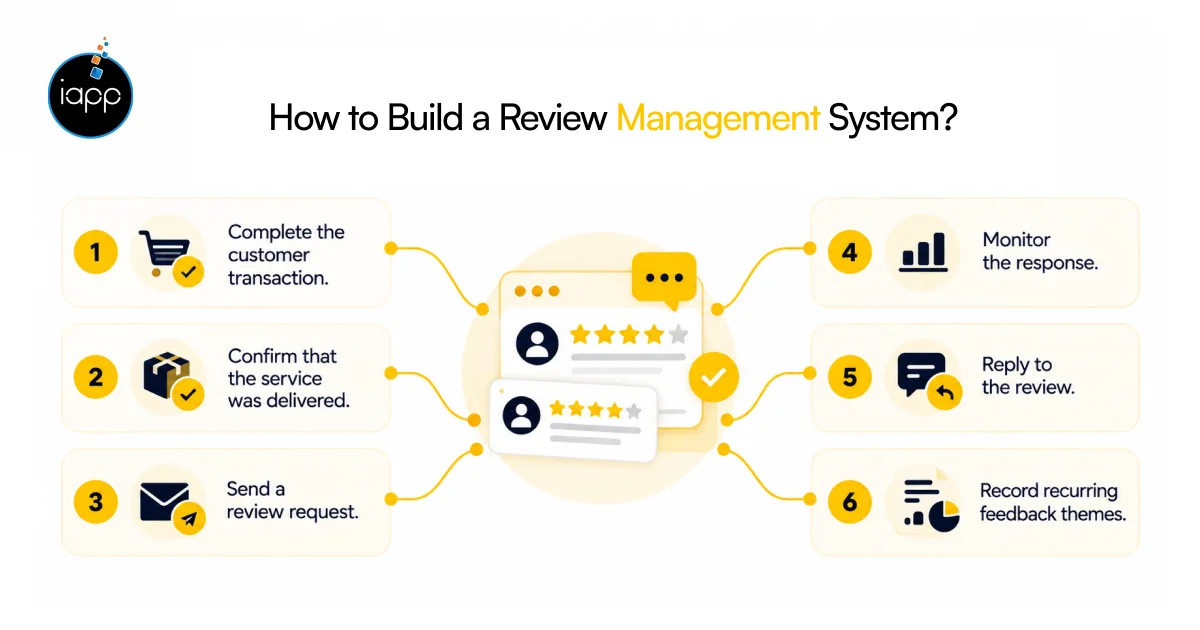
A simple review workflow can look like this:
- Complete the customer transaction.
- Confirm that the service was delivered.
- Send a review request.
- Monitor the response.
- Reply to the review.
- Record recurring feedback themes.
As a planning example, a business receiving 500 completed customer interactions monthly could test a review request at the end of each completed transaction. Do not assume every customer will respond. Instead, measure the actual response rate and adjust timing, message length, and delivery channel.
Your tracking sheet can include:
- Total review requests
- New reviews
- Average rating
- Review response rate
- Average response time
- Recurring complaints
- Positive feedback themes
Avoid fake reviews, paid reviews, and requests that pressure customers into positive ratings. The aim is to collect genuine feedback. It should represent the actual customer experience.
How Should You Respond to Positive, Negative, and Fake Reviews?
The response should depend on the review type. A five-star review does not need the same process as a serious complaint.
| Review Type | First Action | Public Response | Escalation |
|---|---|---|---|
| Positive | Acknowledge | Thank and personalize | No |
| Negative | Investigate | Acknowledge and resolve | If serious |
| Suspected fake | Verify | Avoid public argument | Platform report |
| Viral complaint | Escalate | Controlled response | Leadership or PR |
For positive reviews, avoid using the exact same sentence every time. Mention a relevant detail when possible.
For negative reviews, do not argue in public. First check the customer record and understand what happened.
A practical response structure is:
Acknowledge → Clarify → Offer resolution → Move private
For suspected fake reviews, collect evidence first. Then use the platform’s reporting process if the review violates its rules. Google states that businesses should report reviews that violate policy. A business should not report a review simply because it dislikes the opinion.
Create a severity system for your team:
- Level 1: Normal negative feedback
- Level 2: Repeated service complaint
- Level 3: Legal, safety, privacy, or serious allegation
- Level 4: Viral issue or major media attention
This is one of the most useful parts of an online reputation management strategy. It prevents a routine complaint from receiving the same treatment as a serious reputation issue.
How Can SEO Help Build and Protect Online Reputation?
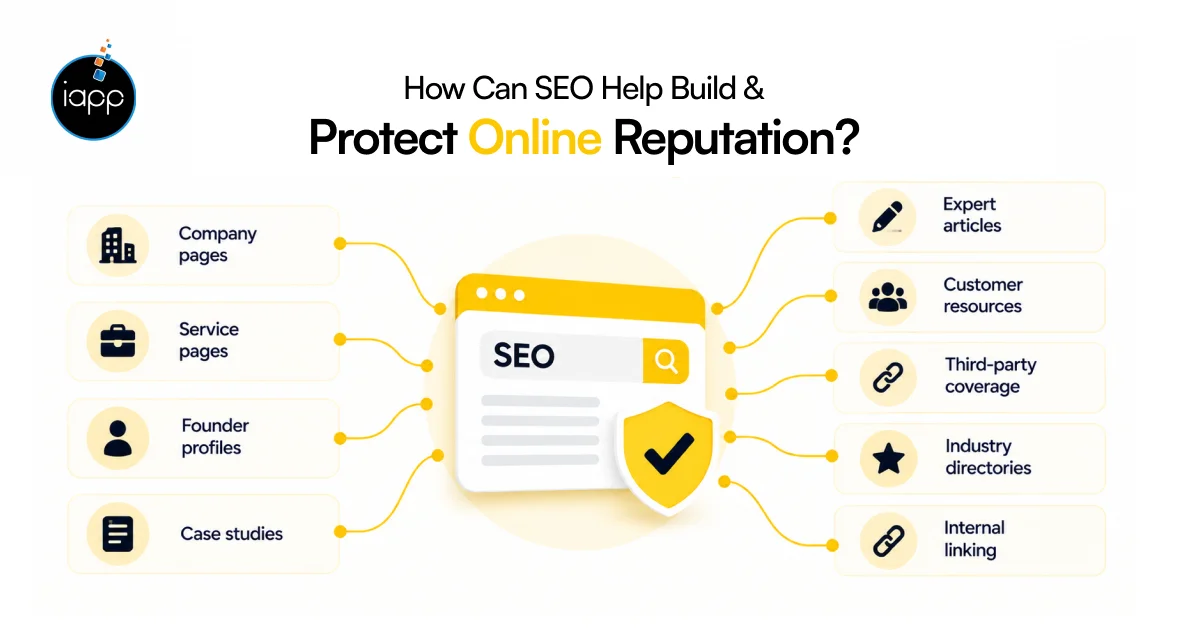
SEO helps control which accurate and useful pages appear when people search for your brand.
This does not mean publishing dozens of pages with your company name. It means building useful assets that answer real questions and support a credible search presence.
Focus on:
- Company and About pages
- Service and product pages
- Founder or executive profiles
- Case studies
- Expert articles
- Customer resources
- Relevant third-party coverage
- Industry directories
- Strong internal linking
There is also an important difference between these three actions.
- Removal means taking content down through a valid platform or legal process.
- Suppression means strengthening relevant pages so less useful results receive less visibility.
- Reputation building means consistently creating credible information before problems occur.
For example, a software company may find an outdated product complaint ranking for its brand name.
The answer should not be ten thin articles repeating the company name. A better approach may include an updated product page, support documentation, customer case studies, expert content, and relevant third-party coverage. That is where SEO and brand reputation management can work together. SEO should support ORM. It should not become keyword stuffing.
How Do You Measure Whether Your ORM Strategy Is Working?
A good ORM strategy needs measurable targets. Track the baseline first, then compare results at 30, 60, and 90 days.
| KPI | Baseline | 30-Day Target | 90-Day Target |
|---|---|---|---|
| Average rating | Record | Improve | Maintain |
| Review response rate | Record | 90%+ | 95%+ |
| Unresolved negative reviews | Record | Reduce | Reduce further |
| Branded SERP coverage | Record | Improve | Expand |
| Positive mentions | Record | Increase | Sustain |
These are planning targets, not universal industry benchmarks. A local business could also track the number of calls or leads associated with branded search traffic. For example, if branded organic traffic produces 100 monthly visits and 12 inquiries, record that baseline. Then compare it with later months.
Track these metrics together:
- Average review rating
- Review volume
- Response rate
- Response time
- Sentiment trends
- Branded search visibility
- Third-party mentions
- Referral traffic
- Leads or enquiries
Do not measure success using review count alone. A business could gain 100 reviews while repeated complaints remain unresolved. That would increase volume without solving the underlying problem.
How Much Does an ORM Strategy Cost?
The price of an ORM strategy depends on factors. The number of platforms, review volume, business locations, and level of monitoring needed all impact ORM. For planning purposes, businesses can use the following ranges:
| ORM Approach | Typical Monthly Cost | Suitable For |
|---|---|---|
| DIY ORM tools | $ 50–$ 300 | Individuals and small businesses |
| Freelancer support | $ 300–$ 1,500 | Small brands with limited channels |
| Agency ORM Services | $ 1,500–$ 5,000+ | Growing and established businesses |
| Reputation crisis support | $ 3,000–$ 10,000+ | Urgent or high-risk situations |
These figures are planning ranges, not fixed market prices. A business with several locations or active reputation issues may need a larger budget. Before picking a service, check what the cost entails. Monitoring, review responses, reporting, SEO, content, and crisis support may be priced separately.
What Are the Most Common ORM Mistakes to Avoid?
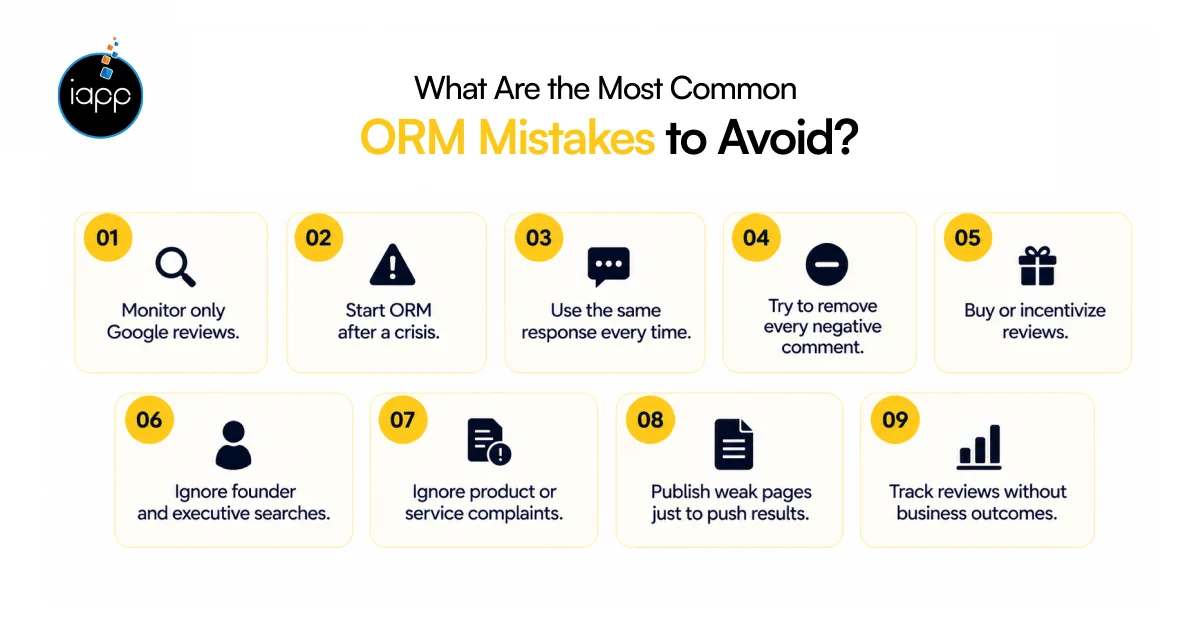
The most common mistakes usually come from treating reputation as a reaction rather than an ongoing system.
Avoid these problems:
- Monitoring only Google reviews
- Starting ORM after a major crisis
- Copying the same response to every review
- Trying to remove every negative comment
- Buying or incentivizing reviews
- Ignoring founder and executive searches
- Ignoring product or service complaints
- Publishing weak pages only to push results down
- Tracking reviews without business outcomes
Another common mistake is separating departments. Customer support may know about complaints. Marketing may manage reviews. SEO may manage branded search results.
However, nobody may own the complete reputation picture. A useful online reputation management services workflow connects these teams through one reporting system.
How iApp Can Help With ORM Strategy
At iApp Technologies, we start with what customers can already find. Our team can review branded searches, reviews, business profiles, social mentions, and relevant third-party pages.
We then classify reputation issues by visibility, severity, and business impact. The result is a practical roadmap rather than a fixed checklist. It can cover immediate fixes, 30-day actions, and longer-term content and SEO work.
Combine ORM With SEO, Content, and Digital PR
ORM work better when reputation signals connect with search visibility. We can optimize relevant company, service, product, and founder pages. Our ORM company can also develop expert-led content around customer questions and important business topics.
Where appropriate, the strategy can include digital PR and relevant third-party coverage. This approach connects ORM services with SEO and content instead of treating reputation as an isolated activity.
Monitor Reputation Signals and Customer Feedback
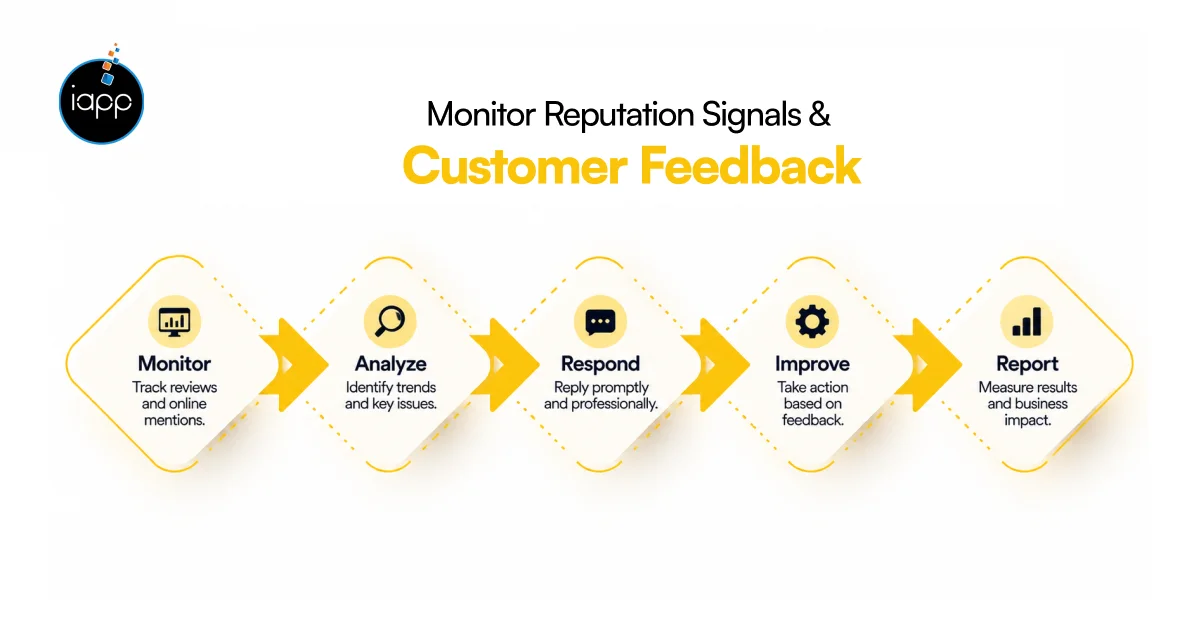
Monitoring gives your team a regular view of what customers and prospects are saying. Our approach can track reviews, brand mentions, recurring complaints, search visibility, and important reputation changes.
The working cycle is simple:
Monitor → Analyze → Respond → Improve → Report
Reports can then show what changed and what needs attention next. For businesses operating across multiple locations, this process can also help compare reputation signals by location.
Turn Reputation Data Into Ongoing Growth Opportunities
Customer feedback contains useful information beyond ratings. Repeated complaints may reveal a missing FAQ or unclear service page. Positive comments may reveal customer benefits worth explaining more clearly. Review themes can also help identify content topics, conversion issues, and service gaps.
This is where our Online Reputation Management Services USA can connect with SEO, content, and broader digital marketing. This approach can work for any business size, from a local company looking for an online reputation management strategy for small businesses to a larger brand managing multiple locations.
Key Takeaways
- Start your ORM strategy with a complete reputation audit.
- Monitor Google, reviews, social platforms, news, forums, and relevant AI search results.
- Build a genuine review-request and response process.
- Treat negative feedback as useful business information.
- Use SEO to strengthen accurate and authoritative branded search results.
- Measure ratings, sentiment, visibility, response rates, and business outcomes.
- Review and update your strategy every month.
Conclusion
Starting an ORM strategy from scratch does not require managing every platform swiftly together. First do an audit, and prioritize important channels. Then, create review and response systems. Strengthen useful search assets, and measure changes over time.
At iApp Technologies, we connect online reputation management strategy, SEO, content, and digital marketing into a practical reputation plan. We focus on improving your online presence through a coordinated approach across key channels.
FAQs
How long does it take to improve online reputation?
Basic fixes can begin within days, while search visibility and reputation changes often need several months of consistent work.
Can online reputation management remove negative reviews?
Only reviews that violate platform rules may qualify for removal. Legitimate negative feedback usually requires a response and resolution.
Is online reputation management worth it for a small business?
Yes, especially when reviews and branded searches influence enquiries. Local services, healthcare, hospitality, and pro firms often benefit from ORM.
What tools can I use for online reputation management?
Google Business Profile, Google Search Console, Google Alerts, review platforms, analytics tools, and social listening software can support an ORM process.
What is the difference between ORM and SEO?
ORM manages public reputation across multiple channels. SEO focuses mainly on organic search visibility, although both can support branded search results.
Can ORM improve my Google ranking?
ORM does not guarantee rankings. It can support a stronger search presence through accurate profiles, useful content, reviews, and authoritative branded assets.
How do I create an ORM strategy for a personal brand?
Start with searches for your name, professional profiles, social accounts, publications, reviews, and third-party mentions. Then address gaps and create useful expert content.
How often should I monitor my online reputation?
High-risk or high-volume brands should monitor daily. Smaller businesses can use weekly monitoring with a deeper monthly reputation review.
How to manage negative online reviews?
Verify the claim, save evidence, and contact the platform or publisher. Respond factually when appropriate. Remember, serious allegations may require legal advice.