Even with excellent content, a business may become less visible in search engines. Instead of using brief keywords, users are increasingly asking comprehensive queries. Therefore, content has to provide a clear and credible response to such queries. AI content optimization blends SEO with practical, useful answers.
It makes it easier for search engines to comprehend your content. Additionally, it aids AI systems in finding relevant data. This guide explains the content AI optimization process, techniques, tools, and measurement.
What Is AI Content Optimization, and Why Is It Important?
Blue links are no longer the only option in search results. Many searches are now directly answered by AI summaries. People now find and use information differently as a result of this. 60% of American adults read AI summaries, according to Pew Research. This survey was carried out in February 2026. That shift changes what effective content needs to achieve.
Clear answers to queries and helpful context are essential components of content. It must also facilitate the identification of crucial information.
AI content optimization assists companies in adapting to these shifting demands. This process gets content ready for search experiences powered by AI and traditional search engines.
Four main areas are the focus of effective AI content optimization:
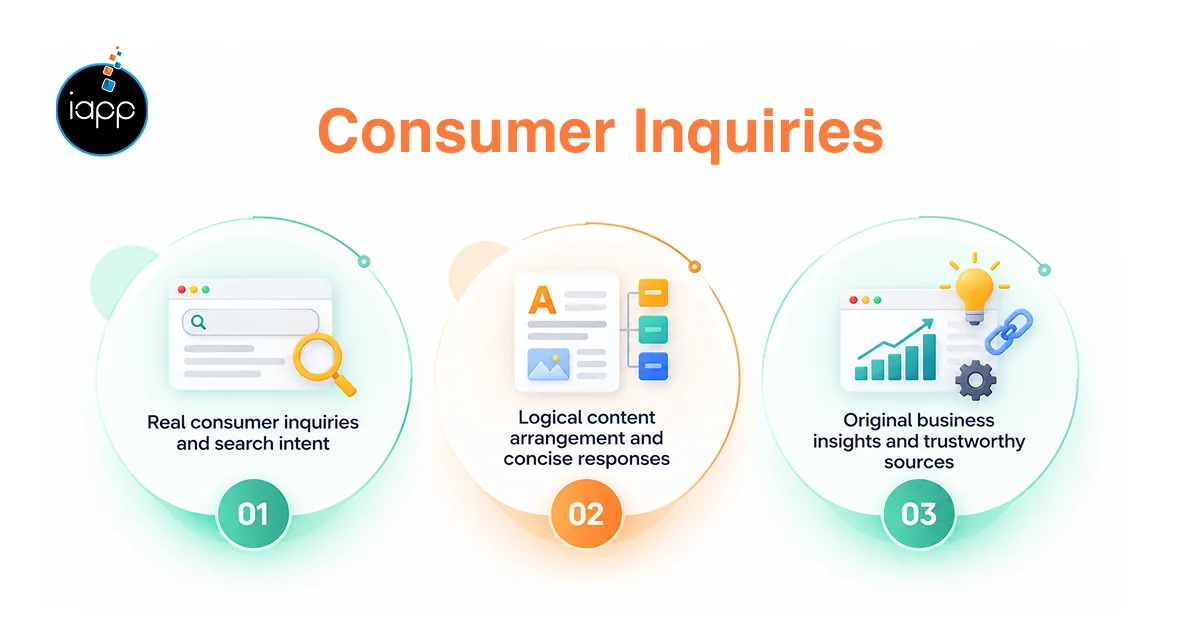
Real consumer inquiries and search intent
- Logical content arrangement and concise responses
- Original business insights and trustworthy sources
- Strong internal connections and technical accessibility
Remember, writing only for AI systems is not the goal. The information should be helpful to people.
How Does AI Content Optimization Differ From Traditional SEO?
The technological basis is still provided by traditional SEO. AI search, however, increases visibility even more.
| Factor | Traditional SEO | AI Content Optimization |
|---|---|---|
| Main goal | Search visibility | Search and AI visibility |
| Content focus | Keywords and intent | Intent, answers, context |
| Structure | Headings and paragraphs | Answers, lists, structured sections |
| Trust | Links and authority | Sources, evidence, expertise |
| Measurement | Rankings and traffic | Visibility, citations, conversions |
Google affirms that SEO is still crucial for AI features. AI Overviews don’t have any unique criteria. These search functions are still supported by current SEO techniques. Thus, companies shouldn’t give up on conventional SEO. Rather, companies ought to link SEO to a more robust content structure.
Take a software startup that targets payroll teams, for instance. “Payroll software” might be focused on by a weak website. A more robust page provides answers to a number of relevant business queries. Pricing, setup, security, and integrations could all be explained. Every response should include specific and helpful information. This creates stronger AI content optimization for SEO.
What Are The Most Effective AI Content Optimization Techniques?
The most effective AI content optimization techniques start by enhancing clarity. Additionally, they facilitate the reuse and verification of information.
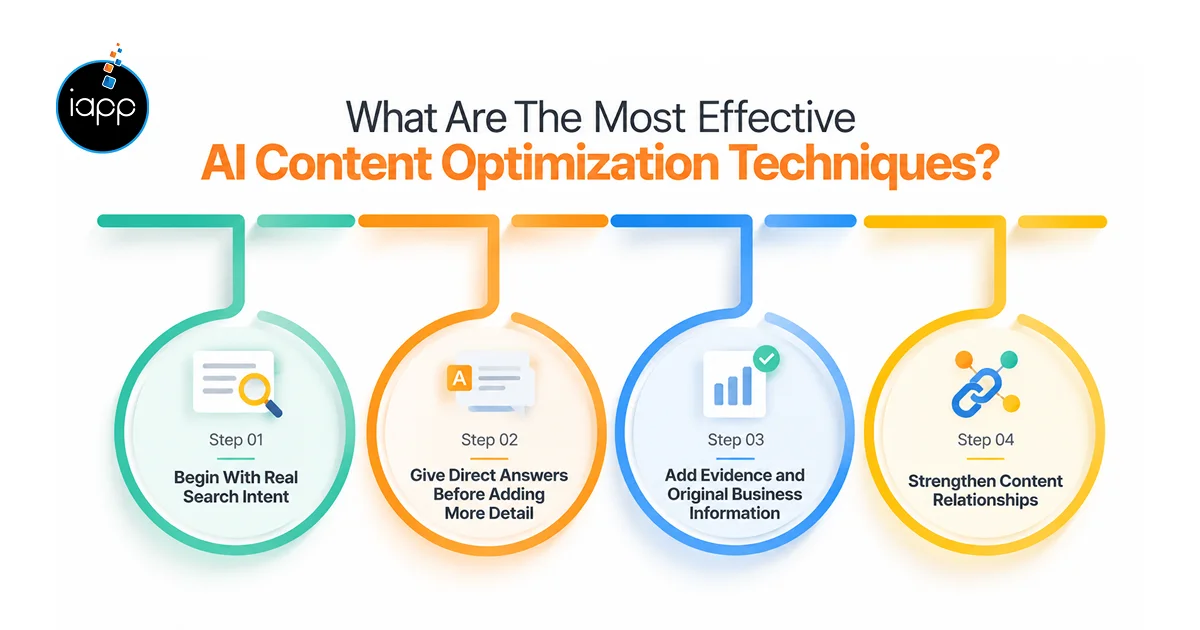
Begin With Real Search Intent
Start with queries that consumers genuinely have on the internet. Next, organize those inquiries around a single main subject. Take into account both commercial and informative search purposes independently. Examine relevant queries from real customer discussions as well.
Give Direct Answers Before Adding More Detail
Start the major section with a direct answer. Next, give a justification for that response. Complex business topics can be better explained this way. Additionally, it supports conversational searches and highlighted snippets.
Pew found that searches with 10 or more words got AI summaries 53% of the time. Question-based searches got AI summaries 60% of the time. So, first answer common questions directly in your content.
Add Evidence and Original Business Information
Generic ideas seldom have an impact on readers. To instill confidence in readers, include figures, references, illustrations, procedures, or professional judgments.
Include stats from credible sites. You may also describe the usual expenses and limitations of the project. This increases the practical usefulness of the content.
Strengthen Content Relationships
Use relevant internal links to link related webpages together. For those links, use informative anchor text. Also organize pages around clear topic relationships.
Headings should be rationally arranged and descriptive. Your site should provide a thorough response to a single topic.
How Can You Optimize Content For AI Search, AEO, And GEO?
Useful information is the first step to optimize content for AI search. Next, make key responses simple to recognize.
AI search optimization encompasses a number of related techniques. These consist of content structure, AEO, SEO, and reliable sourcing.
Direct inquiries and answers are the main emphasis of AEO content optimization.It makes it easier for material to explicitly respond to particular conversational searches. Generative search visibility is the main goal of GEO content optimization. It places a strong emphasis on sources, knowledge, context, and helpful information.
These methods shouldn’t be developed into distinct content strategies. They perform better when paired with solid SEO principles. Additionally, Google recommends original, beneficial, and people-focused content. It cautions against producing enormous quantities without value addition. Therefore, refrain from building pages just around keyword variants. Instead, create helpful pages based on actual client needs.
What Should You Check Before Publishing AI-Optimized Content?
Several checks should be part of a robust publication process.
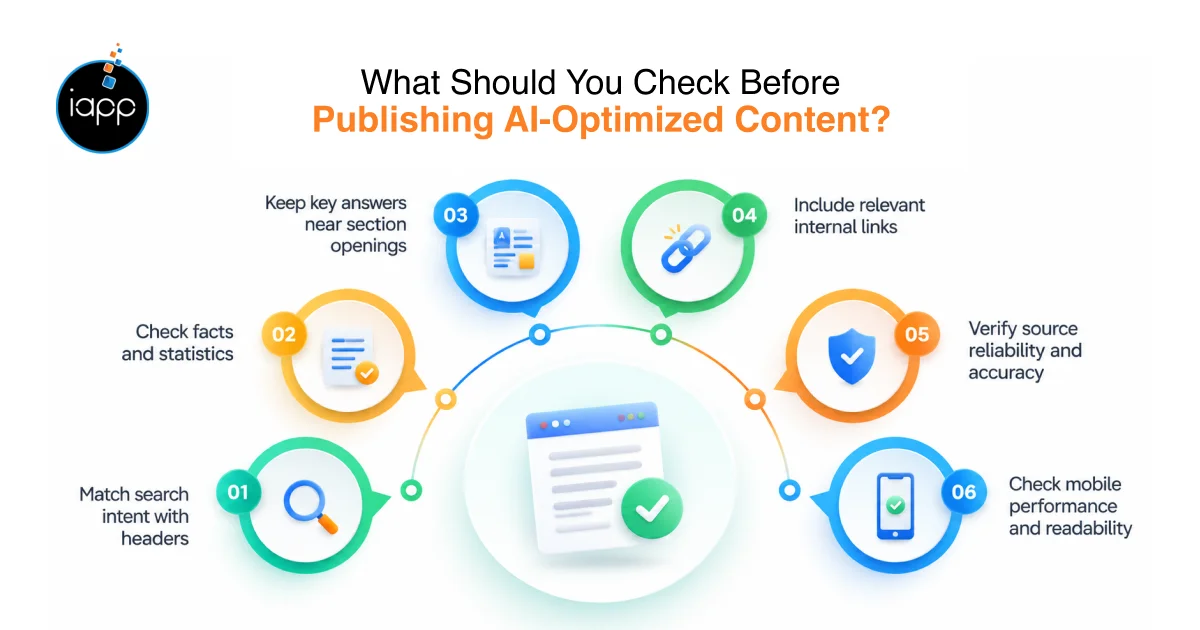
- Check these factors before publishing:
- Check each statistic and factual assertion.
- Compare the search intent with the headers.
- Verify that crucial responses are located close to section openings.
- Include pertinent internal connections.
- Check the reliability and correctness of the sources.
- Verify page performance and readability on mobile devices.
- Verify that the page can be crawled and indexed by Google.
- Ensure structured data matches visible page content.
For AI visibility, technical access is still crucial. Pages must continue to be eligible for search by Google. Additionally, the material needs to be accessible and indexable. This makes technical SEO an imperative element of content optimization.
Which AI Content Optimization Tools Can Help Marketers?
Research and analysis are supported by the appropriate AI content optimization tools.They should not replace editorial judgment.
Here are some useful tools to consider:
- Google Search Console for search performance
- Google Analytics for engagement and conversions
- Keyword platforms for query research
- Content platforms for topical coverage
- AI assistants for research and drafting
- Crawlers for technical content audits
How Do You Measure AI Content Optimization Results?
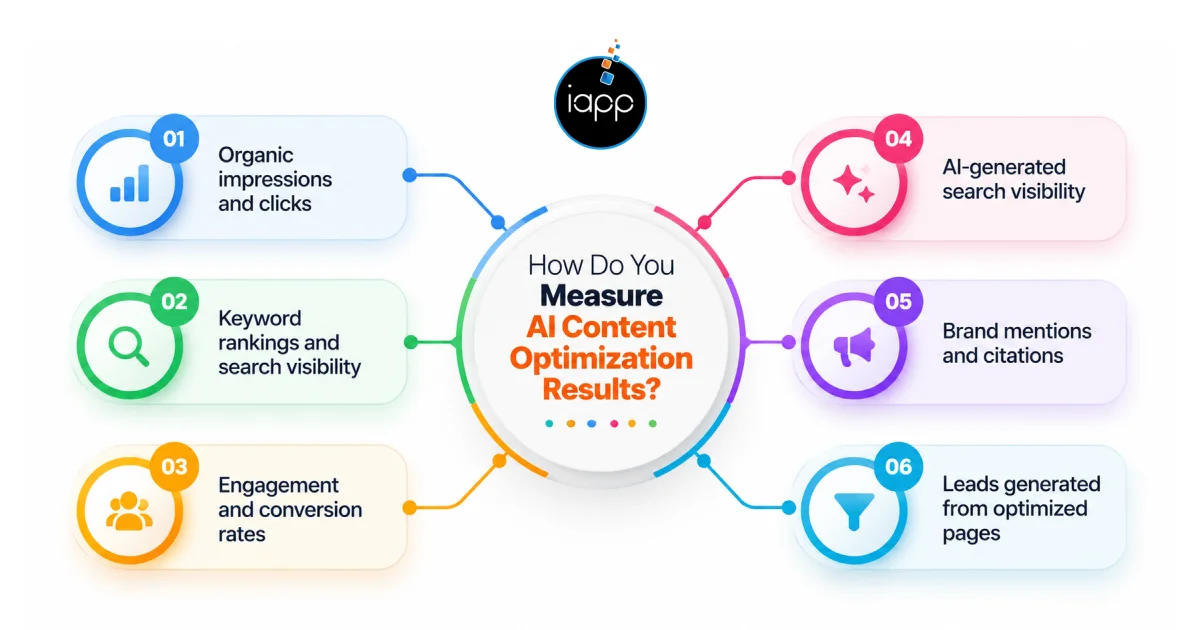
Search data and business results are combined in effective measurement.
Monitor these indicators throughout every content cycle:
- Organic impressions and clicks
- Keyword rankings and search visibility
- Engagement and conversion rates
- AI-generated search visibility
- Brand mentions and citations
- Leads generated from optimized pages
How iApp Can Help With AI Content Optimization
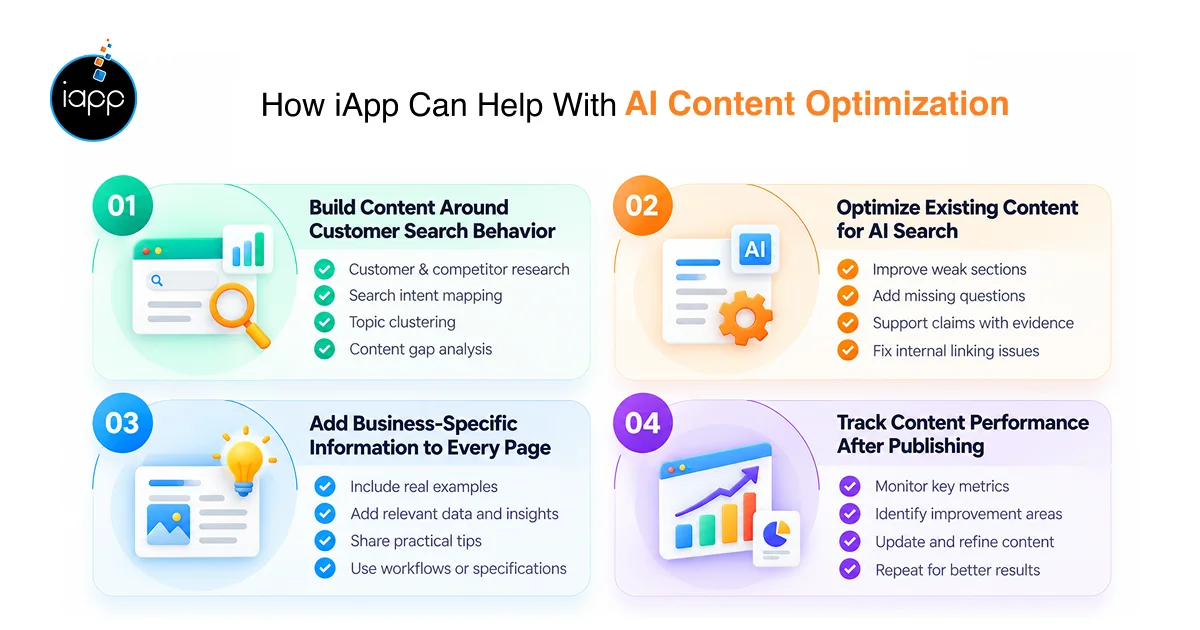
We approach AI content optimization as an ongoing content system. Our first priorities are consumer intent and business objectives.
Build Content Around Customer Search Behavior
Our team first maps user queries to your business objectives. Next, we find worthwhile topics and search for opportunities.
Our process entails:
- Research on customer and competitor
- Search intent mapping
- Clustering of topics
- Analysis of content gaps
- Conversion-oriented content strategy
This maintains the connection between content and quantifiable business demands.
Optimize Existing Content for AI Search
Important information is often already present on older pages. But they could make them less visible in searches.
We examine existing pages for:
- Weak section structures
- Missing customer questions
- Unsupported claims
- Thin explanations
- Poor internal linking
- Outdated information
Then we improve those areas without unnecessary rewriting.
Add Business-Specific Information to Every Page
Readers do not believe generic stuff. We include reliable information, illustrations, and useful suggestions to make content more valuable. This might involve dates for implementation or price ranges. Workflows, technical specifications, or restrictions may also be included. This increases the information value of each page.
Track Content Performance After Publishing
Publishing is just one part of the process. We evaluate performance and pinpoint areas where improvement can be done.
Our cycle includes:
- Research
- Content planning
- Optimization
- Publishing
- Performance tracking
- Content refinement
Key Takeaways
- AI content optimization starts with genuine search intent.
- Traditional SEO remains the technical foundation.
- Direct answers make important information easier to understand.
- Evidence and original insights strengthen content credibility.
- AI content SEO should support people, not machines.
- Measure visibility alongside leads, engagement, and revenue.
Conclusion
Although search is evolving, the most important thing is still useful content. Stronger evidence and more precise responses are now required for effective SEO.
We combine SEO and content strategy at iApp Technologies. Our marketing experts assist companies in increasing their presence in both AI and traditional search platforms.
FAQs
What is AI content optimization?
AI content optimization enhances content for AI and search engines. The strategy focuses on structuring, goals, usefulness, and clarity.
How do I optimize content for AI search?
Clearly respond to real inquiries and provide proof to back up assertions. Also maintain strong SEO, internal linking, and technical accessibility.
Does AI-generated content rank on Google?
When AI-generated content offers real value, it may rank. But Google’s rules can be violated by mass-produced pages that don’t include any helpful or relevant data.
What is the difference between AEO and GEO?
AEO focuses mainly on answering specific user questions. On the other hand, GEO focuses on visibility within generative search responses.
What are the best AI content optimization tools?
Surfer SEO, Frase, ClearScope and WriteSonic are the best tools for AI content optimization. But Google Search Console should also remain part of your toolkit.
How does AI content optimization affect SEO?
It strengthens content clarity while retaining traditional SEO fundamentals. Also, content optimization supports visibility across classic and AI search results.
How can I measure AI search optimization results?
You can track rankings, impressions, clicks, conversions, mentions, and citations.
Also review dedicated generative AI visibility reports.
How long does AI content optimization take?
Initial improvements can take several weeks to implement. You can observe meaningful results in 5-6months.