To demonstrate campaign progress and retain clients, SEO agencies require precise reporting. But it takes time to integrate rankings, traffic, backlinks, and conversions. Teams may monitor outcomes and provide comprehensive explanations of performance with the use of the appropriate SEO reporting tools for agencies. 10 SEO reporting solutions for agencies are compared in this article based on capabilities, reporting, and agency use cases.
Why Do SEO Agencies Need Reporting Software?
Measuring marketing success across channels remains challenging, according to Nielsen’s 2025 Annual Marketing Report. To link SEO efforts with business results, agencies require trustworthy data. SEO reporting software helps in evaluating outcomes, pinpoint issues, and share progress.
Effective SEO reporting software for agencies enhances reporting uniformity and minimizes human labor. Teams may monitor campaign performance across several customer accounts with its assistance.
Top 10 SEO Reporting Tools for Agencies
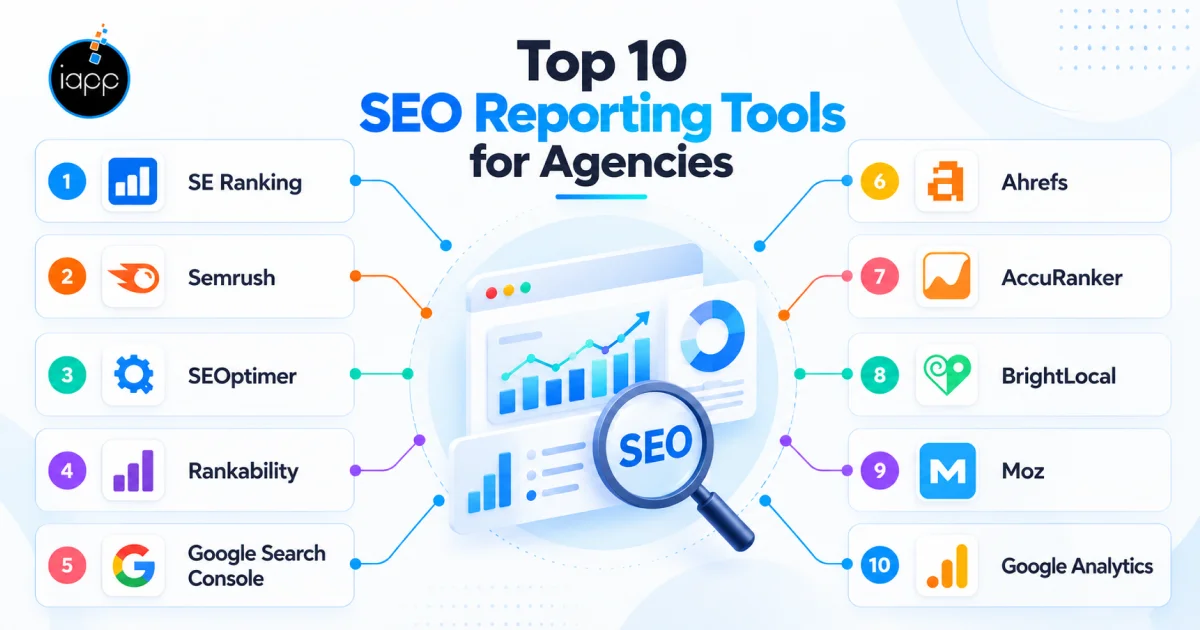
Your clientele, budget, and reporting needs will determine which tool is ideal for you. These SEO reporting tools USA agencies can consider offer different reporting and analysis capabilities.
| Tool | Best use |
|---|---|
| SE Ranking | Agency SEO reporting |
| Semrush | SEO and marketing reports |
| SEOptimer | Website audit reports |
| Rankability | SEO and AI search visibility |
| Google Search Console | Google search performance |
| Ahrefs | Backlink and keyword analysis |
| AccuRanker | Keyword rank tracking |
| BrightLocal | Local SEO reporting |
| Moz | SEO analysis |
| Google Analytics | Traffic and conversions |
1. SE Ranking
SE Ranking is one of the best SEO report generators. It helps businesses run SEO campaigns and several websites. The tool’s platform integrates reporting operations with search visibility analysis.
Key features:
- Website audits and keyword tracking.
- competition analysis and backlink tracking.
- Reports are scheduled, and white-label options are available.
2. Semrush
Semrush assists agencies with the analysis of backlinks, rivals, keywords, and website health. Marketing data is integrated into customer reports through its My Reports function.
Key features:
- PDF outputs and personalized reports.
- Integrations between Google Analytics and Search Console.
- Options for qualifying branding and scheduled reporting.
3. SEOptimer
SEOptimer is a trusted SEO reporting tool for small agencies. It emphasizes client-ready SEO reports and website audits. This software may be used by agencies to pinpoint technical problems and describe improvements.
Key features:
- Automated audits of websites.
- Customized audits and branded reports.
- Tools for agencies to generate leads.
4. Rankability
Rankability facilitates AI search visibility tracking and SEO content processes. Before picking it, agencies should confirm its current reporting characteristics.
Key features:
- SEO content optimization.
- AI search tracking, where possible.
- Agency reporting features (depend on the plan).
5. Google Search Console
Google Search Console displays a website’s Google Search performance. Although it does not have full white-label reporting procedures, offer search data.
Key features:
- Clicks, impressions, CTR, and average position.
- Search queries and landing-page performance.
- Indexing reports and data exports.
6. Ahrefs
Ahrefs assists agencies with backlink, keyword, competitive, and technical SEO research. Campaign planning and organic search analysis are supported by its capabilities.
Key features:
- Backlink analysis with Site Explorer.
- Explorer for keywords and rank tracking.
- Data exports and site audits.
7. AccuRanker
AccuRanker is an expert in tracking keyword rank for larger SEO teams and firms. Teams may track changes in rankings across campaigns with the use of this SEO client reporting software.
Key features:
- Keyword ranking updates.
- Share-of-voice metrics and advanced filters.
- Reporting exports and supported integrations.
8. BrightLocal
Agencies managing local search marketing and business locations are assisted by BrightLocal. Its tools cover citations, reputation tracking, and local rankings.
Key features:
- Tracking of local ranking
- Citation and business listing monitoring.
- Review management and reporting options.
9. Moz
Moz offers agencies tools for SEO monitoring and research. Teams may use it to analyze website performance, assess links, and track keywords.
Key features:
- Keyword research and rank tracking.
- Link Explorer and backlink metrics.
- Monitoring campaign and site crawling.
10. Google Analytics
Google Analytics tracks user activity and website traffic. It can be used by agencies to link organic traffic to conversions.
Key features:
- Organic traffic acquisition reports.
- Landing-page engagement and key events.
- Conversion tracking and performance comparisons.
How Should Agencies Select SEO Reporting Tools?
Select tools according to your budget, reporting requirements, and clientele. The best SEO reporting tools for agencies should offer dependable information and controllable processes.
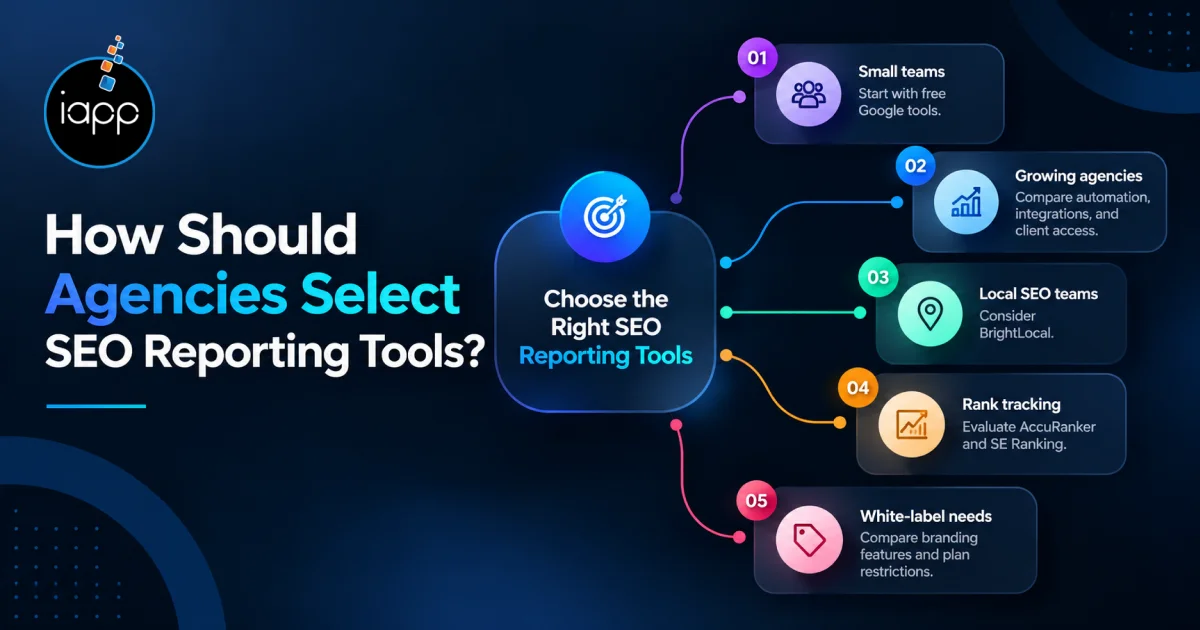
- Small teams: Start with free Google tools.
- Growing agencies: Compare automation, integrations, and client access.
- Local SEO teams: Consider BrightLocal.
- Rank tracking: Evaluate AccuRanker and SE Ranking.
- White-label needs: Compare branding features and plan restrictions.
Evaluate SEO reporting tools for clients using one campaign over 30 days. Compare data quality, reporting time, and client feedback. Verify whether your branding needs are supported by white label SEO reporting tools. Also, compare automated SEO reporting tools USA agencies already use for recurring client updates.
How Can iApp Technologies Support SEO Agencies?
iApp Technologies offers white label digital marketing services to agencies looking to improve their client’s search engine ranking. We offer full SEO or specific tasks as per your needs. Our analysis is supported by appropriate SEO client reporting tools. We can help digital marketing companies in the USA and worldwide to run multiple projects without expanding in-house teams. We are available 24×7 at your services and comfortable to connect with you as per your preferred time zone.
Conclusion
The right SEO reporting tools for agencies depend on campaign size, reporting needs, and budget. Compare features, integrations, automation, and branding before choosing a subscription.
iApp Technologies offers digital marketing services to agencies seeking to outsource SEO. We meet deadlines smoothly and use reliable SEO agency reporting software to track campaigns and share clear results. Discuss your client requirements and reporting priorities with our team.
Frequently Asked Questions
1. What should an SEO report for a client include?
Include rankings, organic traffic, clicks, conversions, completed tasks, and next steps. Connect each metric with business goals.
2. Which SEO reporting tools offer white-label PDF reports?
Relevant branded reporting alternatives are provided by SE Ranking, Semrush, SEOptimer, and BrightLocal. Do not forget to check the features and limitations of the current plan.
3. Can I automate monthly SEO reports for multiple clients?
Indeed. Scheduled reports, templates, and integrations are supported by some platforms. However, prior to automating each client campaign, verify account limitations.
4. What is the difference between SEO dashboards and SEO reports?
Dashboards show performance information for continuous observation. On the other hand, reports, which are often in PDF format, provide a summary of findings for particular time periods.
5. Which tools integrate with Google Analytics and Search Console?
Semrush supports integrations with both platforms through My Reports.
6. How do SEO reporting tools measure organic traffic growth?
They compare landing pages, conversions, organic sessions, and Search Console clicks. Use equivalent periods and account for seasonality.
7. Are free SEO reporting tools enough for small agencies?
Google Analytics and Search Console offer helpful baseline information. However, when organizations want advanced tracking, paid tools are best to use.
Google Analytics and Search Console provide useful foundational data. Paid tools help when agencies need advanced tracking or branded reports.
8. How often should SEO agencies send reports to clients?
Monthly reporting suits many ongoing SEO campaigns. But teams can detect changes in rankings and technological problems more quickly when they do weekly monitoring.